Sponsored
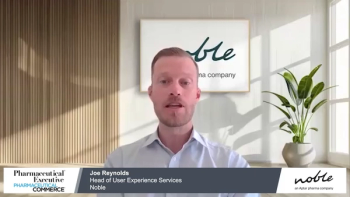
Joe Reynolds, Head of User Experience Services at Noble, breaks down what it really takes for pharmaceutical companies to move therapy from the clinic into the patient's home.
In a discussion on emerging channel strategies, Bill Roth, general manager and managing partner of IntegriChain’s consulting business, explains why DTP models must extend beyond simple cash-pay offerings—highlighting how packaging innovation, insurance-flow backups, and improved patient compliance could unlock new revenue, streamline access, and better reflect clinical outcomes.
In his keynote address, “Navigating Disruption in the Pharmaceutical Channels,” Bill Roth, general manager and managing partner of IntegriChain’s consulting business, described 2025 as a pivotal year for the industry—one defined not just by evolving product archetypes but by the unprecedented acceleration of regulatory change. Although he typically revises his macro framework only once every decade or more, Roth explained that the current environment has forced a significant shift in how he views pharma’s trajectory across generics, brands, specialty, orphan/rare, and cell and gene therapies.
What makes this moment unique, he argued, is the scale and speed of policy transformation. Major regulatory developments—including the Medicare MFP program, the introduction of the 340B rebate, changes to the MDRP, and updates to the physician fee schedule—are reshaping commercial strategies in real time. He noted that manufacturers are now making preemptive changes to pricing and contracting before regulations take effect, a behavior he described as virtually unheard of in past cycles.
Roth emphasized the importance of looking beyond the policies themselves to understand their downstream commercial effects. For example, he predicts significant WAC reductions across the market and a long-term decline in 340B value as new rules strip margin from the program. He also introduced a new concept—the “medical benefit bubble”—warning that once MFP values fold into ASP for medical benefit products in 2028, the resulting gap between WAC and ASP will likely force further WAC compression.
Another emerging area of disruption is the industry’s rapid shift toward direct-to-patient models. Roth highlighted ongoing debates about whether this movement is driven by genuine operational advantage or political and public-perception pressures. His goal for the keynote was to provide a broad, high-level map of these intersecting forces—an approach he believes resonated strongly with attendees.
He also commented on other topics that have piqued his interest; his new six-part series; and much more.
A transcript of his conversation with PC can be found below.
PC: What has been on your radar in terms of other sessions/topics at the show?
Roth: For me, I take the topic of DTP, and I want to layer it up underneath the insurance patient journey flow because I don't look at it as it's either insurance or it's cash. I'm looking at it more in the way that if the insurance journey fails the patient and the prescription at any point, we want to have the cash option right there. So obviously, when a drug isn't covered, have the cash option ready. If the patient can't deal or doesn't want to deal with all the utilization management aspects—like a step edit, where I have to go back and fail on this drug in order to get the drug that the doctor wants me to be on—I can bypass that.
One of the questions I asked this morning at a great direct-to-patient panel that Knipper was hosting, was this whole concept of our unit of packaging. I'm not a fan of our products being put in an amber vial. The pharmacies like it because that's what creates the conversion from brand to a generic. But if I'm a brand, I want it to be in my package. And so I think there's an interesting thing that Lily did by if you're using cash, you have these vials.
If you're using insurance, you have the auto injector. And this idea was like, what if we were to put compliance packaging out there, branded, and you could actually get more sales, because our average rate of compliance for consumption of a prescription like a maintenance med is only 75%. If we put it in compliance packaging, we could actually add 25% to our revenue, get a more compliant patient, which then, in turn, should match the outcome that we studied in the clinical trial.
I think there's more than just a simple like, hey, let's throw up a DTP site and make it a cash play. I think it's a bigger topic, and so that's my big point of curiosity at the moment.