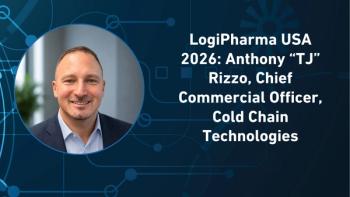
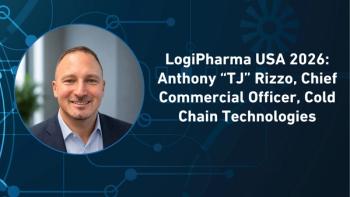
At LogiPharma USA 2026, Cold Chain Technologies' Anthony "TJ" Rizzo discusses cold chain expertise gaps and how data tools are reshaping the profession.
Anthony "TJ" Rizzo explains how modern tools are enabling more oversight and precision within the cold chain.
As pharmaceutical supply chains become increasingly global, time-sensitive, and patient-centric, the ability to operate continuously across geographies is no longer optional, it is foundational. From biologics and cell and gene therapies to temperature-sensitive vaccines, the stakes in cold chain logistics have never been higher. Industry estimates suggest that the global pharmaceutical cold chain logistics market is projected to surpass $30 billion by 2035, driven by the rapid growth of specialty drugs and stricter regulatory expectations around product integrity.¹ At the same time, increasing shipment complexity, climate volatility, and geopolitical disruptions are exposing the limitations of traditional, static cold chain models.²
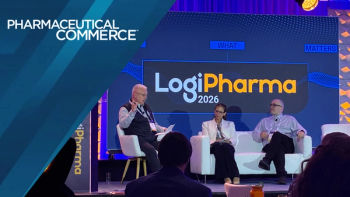
Against this backdrop, automation and real-time monitoring are emerging as critical enablers of a more responsive and resilient supply chain. At LogiPharma Europe 2026, Anthony “TJ” Rizzo, chief commercial officer at Cold Chain Technologies, explored this shift in his session, “Operating in a 24/7 Global Market: How to use automation and real-time monitoring to enable faster response, greater agility, and better risk control.” Drawing on decades of industry experience, Rizzo outlined how digital tools are transforming cold chain management from a retrospective, investigation-driven process into a proactive, data-informed discipline.
In this exclusive interview with Pharmaceutical Commerce, Rizzo expands on the operational realities behind that transformation. He highlights how automation and real-time visibility help companies navigate unpredictable transit conditions, reduce reliance on overengineered packaging, and address persistent challenges such as data silos and limited in-transit insight. Just as importantly, he emphasizes that these technologies are reshaping regulatory compliance, moving the industry toward continuous monitoring, stronger data integrity, and risk-based decision-making aligned with evolving global standards.
Rizzo also underscores the importance of collaboration across the supply chain ecosystem, particularly between shippers and solution providers. As he explains, the true value of real-time data lies not in its collection, but in how it is used to drive outcomes, whether improving lane design, enabling earlier interventions, or strengthening overall supply resilience. With automation, analytics, and human expertise working in tandem, the cold chain is steadily evolving into a more integrated, predictive, and patient-focused system.
Watch all three parts of Rizzo’s interview with PC:
1.
2.
3.
Editor's note: This transcript is a lightly edited rendering of the original audio/video content. It may contain errors, informal language, or omissions as spoken in the original recording.
Rizzo: There's a lot of, discussion in the industry specifically about automation, real-time monitoring, and the value specifically of that. You know, and from our standpoint, really one is to deal with unpredictable real-world conditions. Automation and monitoring help manage delays, climate extremes, infrastructure variability that qualified packaging alone cannot fully absorb. there's a lack of in-transit visibility, which kind of ties back to that, which, real-time data can help shift cold chain management from the post-delivery investigation to early detection and intervention. We have some fragmented systems and data silos, so an integrated digital platform can replace disconnected monitoring and reporting across multiple partners and handoffs. And, finally, I'd say, ineffective risk mitigation. You know, we have data-driven tools to help reduce both over-engineering for reassurance, but also, help under-protection that leads to excursions. So a lot of opportunities, specifically, with automation and real-time monitoring to address some of those challenges.
You know, we're seeing that compliance is becoming continuous, not retrospective, right? Regulators are increasingly expecting evidence of control through transit, not just through qualification and shipment release, but through, whether it be temperature monitoring, proactively or as part of a continuous monitoring plan. There's a stronger focus on data integrity and auditability. Automated systems must be able to generate secure, traceable, and defensible data suitable for quality and regulatory reviews. Really the pharmaceutical industry, as a whole, operates on a risk-based compliance, overall. And automation enables leaders to prioritize higher-risk routes, products, and seasons in line with regulatory expectations. The final thing I'd mention is that technology must sit within a validated process, right? We talk a lot about packaging being qualified, not validated because you can't control the distribution channels, right? But the technology that supports it should be validated, and those digital tools strengthen compliance when they're aligned with GMP frameworks and human oversight.
I think we are really focused around outcomes, not just tools. So successful partnerships focus on patient safety, supply resilience and performance, not just the technology deployment alone. The conversation has always been - we can get real-time data, but what do you do with it? We're focused on that outcome. Early upstream collaboration is critical. The greatest value comes when solution providers support lane design, packaging strategy and risk modeling before shipments move. and when you're sharing data, you share accountability, so trust and transparency are essential for interpreting data, managing exceptions and driving improvement. And, you know, I think this ties back to the MedAssure launch for us - that digital insight is great, but it also needs to be supported by human expertise. So the technology identifies risk, but experienced teams on both sides make the decisions to-- that properly protect product integrity.
This is one of the most exciting changes that's happening here today. We're moving from a static assumption that's been driven by a qualification to more dynamic planning. With some great tools that we've been talking about and data available so that, that move is allowing us to model risk against real-time variability, not just historical averages. Again, that can be from changes in weather versus historical, but also as you mentioned, transit routes changing due to either geopolitical or other impacts. Ultimately, earlier identification of any systematic vulnerability is a good one as well with this. Analytics highlight where lanes, regions or handoffs are most likely to fail before disruption escalates. It gives you the ability to act, to try to reduce the likelihood of events. And, resilience becomes proactive and not reactive in that case. So real-time visibility enables intervention while shipments are still recoverable. And we talk about impacting the patient or the receiver, right? If you're able to intervene before that, it helps you minimize the impact ultimately to the person receiving it and ultimately to the patient. And, I think finally on that question, is that risk management embeds into daily operations. It becomes more of a mind shift. So resilience shifts from crisis response to built-in operational capability, it just becomes more of a muscle that you start to flex more often rather than just when you need to.
You know, I think there's been a lot of shifts here, at least in my time, within the marketplace, from primarily customized packaging to off-the-shelf packaging to a huge move into reusability, into sustainable, curbside recyclable alternatives. We’re in the era right now of where this technology we've been talking about, whether it be control towers and real-time monitoring and automation and AI, is really going to continue to just explode over the next five years in particular. You're going to see a greater convergence of packaging data and expertise. Cold chains will continue to move towards integrated thermal assurance ecosystems rather than standalone solutions. We're doing a master's class here at LogiPharma specifically on this area because, again, moving from a static, chamber qualification that says that this is how the packaging will perform against these in this environment, moving toward more of a one where packaging freight and data really help you drive the most cost-effective, the most sustainably effective, and really the highest quality type of solution for each type of shipment. There's going to be more predictive cold chain management on that realm. Modeling and analytics will increasingly guide packaging selection, lane qualification, and ultimately contingency planning to help deal with some of these impacts that we see, like currently what we're seeing with the Iran war. There's going to be more efficiency through precision and not excess. Better risk intelligence will help reduce unnecessary overengineering cost and ultimately carbon impact. And I think finally, technology is going to augment, not replace human judgment at the end of the day. The most resilient cold chains will combine automation and experienced oversight. I think it's going to be a while before we get to a fully autonomous system here. And then there's so many variables in place to address any potential issues that come up. So, I think you're going to continue to see that experienced oversight utilizing automation and artificial intelligence in order to help make smarter solutions overall.