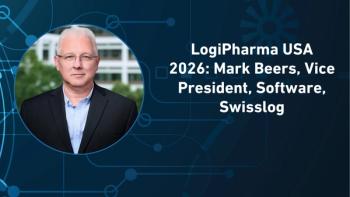
Swisslog's Mark Beers discusses how software helps pharma supply chains adapt to shifting portfolios, strengthen inventory verification and build trust.
At LogiPharma USA 2026, quality leaders explained why connected data, risk-based prioritization, and human accountability must come before AI in supply chain compliance.
As regulators sharpen their focus on how quickly the industry responds to disruption, quality and compliance leaders are rethinking how data, technology, and people fit together. That was the theme of “Strengthening Quality & Compliance Risk in a Volatile Global Supply Chain,” a panel session at LogiPharma USA 2026 in Boston,
Moderated by Mark Beers, VP of software at Swisslog, the panel featured Gisele Fahmi, director of internal manufacturing operations quality at Pfizer, who leads QC digitization and master data, and Marcio Alves da Silva, project manager in the Temperature Control Support Center at Johnson & Johnson, whose group supports global transport of finished pharma and medtech products.
“Health authorities are starting to look not just at how you react when something goes wrong, but how fast you can react,” said Alves da Silva. “We need to be not just reactive, but predictive.” He cited J&J’s COVID-19 vaccine rollout, when the team had to be ready to ship upon approval, as the kind of adaptability regulators now expect.
Fahmi framed preparedness through ICH Q9(R1), which connects quality risk management to product availability. “Being prepared is really quality readiness aligned directly with supply readiness,” she said. “We cannot live disconnected, from manufacturing to quality to supply chain. We need those connections across.” That starts with fundamentals: approved specifications and methods and reliable master data.
Asked where the biggest risks are emerging, Fahmi pointed to dependencies between labs and production: manufacturing changes ripple into test specifications, while lab results govern batch release. “Manufacturing, supply chain, and quality need to talk to each other,” she said. “We have a lot of data, but do we have the right data connecting each team together?”
Alves da Silva stressed calibrating effort to severity. “We do not need to treat all risks the same,” he said. Some products have stability data supporting weeks of temperature excursions, while newer products cannot tolerate even small variations. “It does not mean that I’m not going to monitor or track this other product, but I do not need to invest so much in it.”
On technology, both panelists embraced AI while insisting on human accountability, a position
“To be able to rely on that information, we need to understand how that AI was created [and] what data [were] used,” Alves da Silva said. “In the end, our company is still accountable for whatever happens. We cannot just say the AI decided. We need to understand why it did.”
Fahmi agreed. “We still need qualified people to make critical quality decisions,” she added. The goal, she said, isn’t for AI to think for people but to teach them what they don’t know. She offered her own formula: “Start with a standard process, trusted master data, then a common platform, and then AI comes at the end.”
She also cautioned against leading with the technology, saying “The very practical question we need to ask is ‘What problem do we really need to solve?’” AI can clean data faster than humans, she noted, but it cannot connect departments.
Alves da Silva extended that logic to the cold chain,
Alves da Silva described distribution center (DC) staff handling storage excursions by consulting as many as seven differently formatted documents from across the organization, delaying release. J&J’s fix was translating those inputs into a single tool and common language for the DC. “That provides more autonomy for the DC to take action,” he said.
Fahmi recounted tackling the same recurring investigation problem twice, four years apart, first with automation to search historical data, then with an AI agent. Root-cause work that once took about 30 days shrank to a few days, though a human remained in the loop.
Looking ahead, Fahmi named data readiness as the most important capability, connecting not only systems but teams into an ecosystem. “That’s the most challenging,” she said, “but it is critical and important for us to be successful with the AI and the future of the AI.”
Alves da Silva named communication and clarity of purpose. “If we don’t have good data quality, we cannot have a good answer,” he said. “But if we don’t have a good question, we don’t know if the data that we have will answer that question.”