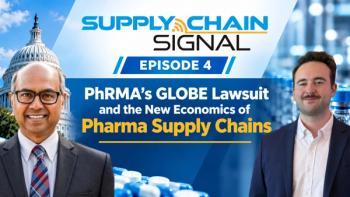
Episode 4 of Supply Chain Signal examines PhRMA’s legal challenge to CMS’ GLOBE model and whether manufacturers can lower costs, expand U.S. production and strengthen supply chain resilience all at once.
The Supreme Court invalidated IEEPA-based tariffs, but pharmaceutical tariffs imposed under Section 232 remain in effect.
It is critical for industry leaders to recognize that most high-profile pharmaceutical tariffs discussed in 2025 were intended to be imposed under Section 232 of the Trade Expansion Act, rather than the International Emergency Economic Powers Act, often referred to as IEEPA.² In spring 2025, the Department of Commerce launched a Section 232 investigation into pharmaceutical imports and ingredients to assess potential national-security risks. President Trump subsequently announced plans for a 100% tariff on branded or patented pharmaceutical products specifically linked to that investigation.
Consequently, the Supreme Court's ruling against IEEPA primarily affects mega-tariffs and global reciprocal actions, while pharmaceutical-specific measures grounded in national-security authority remain potentially in force.² For example, Section 232 tariffs on steel and aluminum are separate and remain in place even after this decision. Furthermore, negotiated exceptions and trade agreements with the UK and EU were designed to shape how Section 232 duties on drugs would be applied, distinct from the broader emergency powers recently curtailed. This means that while some broad import taxes are gone, the targeted investigations into the pharmaceutical supply chain have not been directly invalidated.
On the tariff developments, Kristin Ciriello Pothier, Americas Life Sciences Leader, KPMG, comments, "Today's ruling and subsequent developments are only part of the story for the life sciences industry, leaving key questions around tariff exposure and trade uncertainties. Now is the time to pressure-test sourcing models and accelerate AI-driven forecasting. Resilience and disciplined scenario planning will be essential as trade dynamics continue to shift."
The tariffs have caused the industry pivot toward domestic manufacturing, which has accelerated global trade tensions.³ Major developers have already committed billions to reshoring to mitigate potential duties and ensure supply chain resilience. For example,
This massive reallocation of capital responds to an invest-or-tariff ultimatum, where high taxes could be avoided by beginning US facility construction.³ This is a vital shift, as 90% of biotech firms rely on imported components for at least half of their approved products. High costs have already squeezed profit margins, forcing some companies to delay R&D. While the court decision limits broad emergency taxes, onshoring continues to provide benefits like improved quality control and reduced miscommunication. Manufacturers are now prioritizing trade compliance and supplier diversification to balance domestic capacity with flexibility. The industry continues to advocate for stable policies to protect critical inputs like APIs and excipients. By investing in domestic R&D and localized APIs, firms aim to strengthen medicine supply security for the future.
References