APIIC's Brian Doty says renovating shuttered US plants with advanced manufacturing is faster and cheaper than building new to reshore generics.
APIIC's Brian Doty on how repurposing shuttered U.S. plants with advanced manufacturing could make domestic generic drug production viable.
Bringing more generic drug production back to the U.S. may depend less on building new plants than on making better use of the ones already here. According to the API Innovation Center (APIIC), advanced manufacturing technologies can be installed in existing, idle facilities, allowing generic manufacturers a way to make domestic production pay despite thin margins.
The supply risk behind that push runs deep. In Senate testimony, APIIC chair and founder Anthony Sardella described a study of 40 vital medicines that are clinically essential and often in shortage. Where data were available, it found that 47% of their key starting materials (KSMs) come only from China.1 On the API side, 83 of the top 100 generics prescribed in the U.S. rely on foreign-sourced active ingredients. The Senate Special Committee on Aging cited that finding in its October 2025 report.2
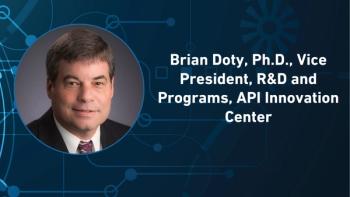
Brian Doty, Ph.D., vice president of R&D and programs at APIIC, spoke with Pharmaceutical Commerce about what that dependence means for the companies that sell these drugs and the patients that purchase them. He also discussed how repurposing existing capacity compares with building new plants on cost and timing, and what would need to change for generic manufacturers to
Watch Doty’s interview with PC:
Doty: We do make active ingredients — some in the U.S. — but not as much as we should. The key starting materials are really where we need to focus our efforts to make sure that those are also sourced from either U.S.-sourcing or friendly countries. If you look at some of the statistics, the active ingredients that are used in the top one hundred generics, which is about 90% of all drugs that are prescribed in the US, 83 of those top 100 utilize active ingredients that are foreign-sourced. This just tells you the implications and the depth of reliance on foreign sourcing for our molecules in the U.S. Not having a reliable source, one that we can control quantity as well as quality and even pricing, puts us in a very vulnerable position as a country, especially on 83 out of the top 100 generics that are prescribed. It’s definitely very difficult for us to be able to have supply chain resiliency with that in place.
Advanced manufacturing technology and API synthesis is utilizing different types of synthesis processes and monitoring technologies. We utilize continuous flow chemistry, which is replacing what's considered today's standard of batch chemistry, and being able to manufacture high-quality materials in a shorter period of time. It's a much smaller footprint. If you think about a normal chemical plant, they usually have these huge tanks, three stories high, that are utilized for one step of one process. With continuous flow chemistry, we're able to utilize that to generate many different reaction sequences in a row and do that in a continuous process, making it much more efficient and a smaller footprint for the operations. It allows us to be able to put this into existing facilities, which to us makes a lot more sense from the perspective of being able to repurpose existing facilities and not have to build new facilities, which oftentimes is very costly and time-consuming. We are talking about the generics space, so margins are very thin and costs associated with the process needs to be under control. For us to be able to influence manufacturers to make that change, we have to show up with a good business case, and this is really one of the few ways that we can do that.
It's very difficult to go from greenfield, build a new facility and be able to make it profitable in the generics space. Again, the margins are very small on all the generic products that we know today. But the time to build a facility — you're talking several years, maybe four to six years, to actually get a full facility built and in place. If you're renovating an existing facility, that can be done in less than a year, usually around six months depending on the needs there. It's obviously much cheaper to renovate versus trying to build new.
The other part is the equipment that you're putting in there. If you're utilizing advanced manufacturing technologies, you can utilize a much smaller footprint and therefore you can put more into existing spaces. And those spaces do exist in the U.S. One of the studies that was done when Anthony Sardella and Kevin Webb founded APIIC was to look at the capacity that was available in the U.S. Really, there's probably about 50% of that still available that is just at this point shut down and could be repurposed for us to be able to put advanced manufacturing technologies in and be able to optimize that space utilization.
Something we talk about every day is how do we make that happen? As I said earlier, the generics space is very low margin, so it's very difficult to make change. When people have manufacturing lines running, they don't want to invest additional funds into that because they may not get return on investment. The business case has to make sense to them. What API Innovation Center has modeled is really investing in that development piece of that, so they're able to manufacture utilizing advanced manufacturing technologies without significant outlay of capital on their own. Eventually, the efficiencies you get from that will pay for themselves.
I think it's really the business case piece of that, helping out manufacturers with that development piece, as well as also looking at policy. Government has supported what we're doing, and it shows that reshoring critical medicines is working and by some of the progress we've made here at APIIC. But also, being able to set up with these manufacturers the ability to utilize their sites. They've been very forthcoming with that. Policy changes — government can work on that and make preferred providers and make some incentives to customers for buying American-made. There's a whole host of things that can be done. I really feel like this is a true opportunity for us. It's not something we can't overcome.
Offshoring these medicines made sense a long time ago, and it's happened over the last 20 to 30 years. Companies did that to stay cost competitive and be relevant in the market, and now we're starting to see the implications of that. That's where the API Innovation Center can help with the reshoring piece of that and be able to make this affordable for manufacturers to take this on.
1. Sardella A. Statement for the record. U.S. Senate Special Committee on Aging. Prescription for Trouble: Drug Safety, Supply Chains, and the Risk to Aging Americans. October 3, 2025. Accessed November 9, 2026.
2. U.S. Senate Special Committee on Aging. Protecting Seniors’ Access to Essential Medications: Securing the Foreign Generic Pharmaceutical Supply Chain. October 20, 2025. Accessed November 9, 2026.