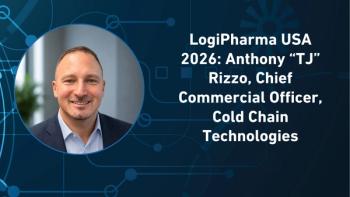
At LogiPharma USA 2026, Cold Chain Technologies' TJ Rizzo explains how gaps in end-to-end cold chain expertise create risk for advanced therapies.
AI-driven cold chain visibility is only as reliable as the data behind it, exposing gaps between compliance, monitoring, and true product conditions.
The pharmaceutical supply chain is rapidly entering its “AI-first” phase. Control towers predict delays, reroute shipments, and promise real-time visibility across increasingly complex global networks. But there is a layer of failure these systems don’t capture. Not because it is too complex, but because it is invisible to the data they rely on.
Modern cold chain systems are built around a compelling idea:
The result is a dangerous paradox: systems that are technically compliant yet operationally misleading. A facility can pass validation, generate clean reports, and still miss transient 2–3°C excursions, which is exactly the range that can accelerate degradation in temperature-sensitive biologics over time.
Cold storage environments are often treated as uniform. In reality, they behave as dynamic thermal systems influenced by airflow, load patterns, and operational activity. Within these systems, localized “thermal dead zones” form—areas where temperature deviates from the average environment. These zones commonly appear:
A single-point sensor, regardless of its precision, cannot capture these variations. Even highly accurate devices only validate the conditions of their immediate surroundings. This is not a limitation of technology alone. It is a constraint imposed by physics.
The industry frequently equates real-time connectivity with real-time truth. However, real-time systems only ensure that data is transmitted instantly—not that it is captured at the right place or moment. Most monitoring approaches still rely on:
This creates blind spots. A short temperature spike occurring between intervals may go completely undetected. A localized hotspot just outside the sensor’s range remains invisible. In both cases, the system continues to report stability. Even connected, in-transit monitoring tools designed for live tracking can only report what their sensing point experiences—not the full thermal profile of a shipment. AI models built on this data cannot compensate for what was never observed.
Many cold chain monitoring systems are designed primarily to meet compliance requirements. These include:
While these capabilities are necessary, they do not guarantee that the data reflects actual product conditions. Regulatory expectations are gradually shifting. The focus is moving from whether data exists to whether it accurately represents the environment experienced by the product. This distinction introduces a critical concept: defensibility.
A compliant system answers a narrow question: did the recorded temperature remain within predefined limits at the sensor location? A defensible system answers a broader one: did the product remain within acceptable stability conditions throughout its environment? Achieving this requires a more deliberate approach to monitoring, including:
Without these considerations, monitoring efforts focus on validating sensors rather than safeguarding products.
The industry does not necessarily need more devices. It needs better measurement strategies—ones that reflect how temperature actually behaves across facilities and shipments. In practice, this often requires combining different monitoring roles:
Individually, each of these approaches captures only a slice of reality. Fixed systems may miss localized disruption within shipments, while mobile devices can overlook broader environmental instability within facilities. Single-use loggers, while not real-time, often provide the most defensible record during post-event analysis. When deployed together, however, they begin to approximate ground truth—bridging the gap between system-level visibility and product-level reality. The objective is not more data, but more representative data.
As the industry invests in AI-driven visibility, it risks overlooking a fundamental dependency: data quality. Without accurate inputs, even advanced systems operate on assumption. The next phase of cold chain innovation will not be defined by more dashboards. It will be defined by better truth.